
Play and Deception
Deception as the Primary Principle of Play

“If you want to be creative, stay in part a child, with the creativity and invention that characterizes children before they are deformed by adult society.”
― Piaget
I can watch a youth player skate and know if he trains at that 3-letter big box academy or with youth coaches that love cones and drills. And apparently I’m not alone:

Boring.
Clunky.
No flare.
Head down.
Shoot really hard but can’t get open to get their shot off.
No deception.
Because they don’t ‘play’.
Fun Fact… The UN considers play so important that they've deemed it an inalienable right.
Play isn’t only good for children physically, mentally, emotionally and spiritually… It’s good for developing their ‘game’.
Team play deals with group cohesion amongst teammates and the ability to deceive opponents to invade good space.
Play is a requirement.
Deception is a prerequisite to playing ‘well’.
The thesis… Deception is the most important principle of play. And that play, or the lack of it, is driving the mass-production of very boring, non-talented hockey players.
Buckle up…
First, Set the Environment
“Children learn as they play. Most importantly, in play children learn how to learn. ”
O. Fred Donaldson
Contemporary American martial arts master
1v1, 2v2, 3v3 street hockey is how we learned the game as kids. We learned to get open for a pass, separate from our check, pick to create space for a teammate, and score in ways the other team got to call out for us.
We didn’t learn to be deceptive doing this:
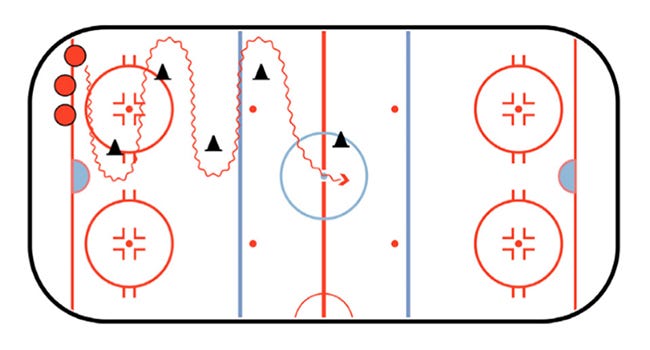
To Invade, You’ll Need to Decieve
“All warfare is based on deception. Hence, when we are able to attack, we must seem unable; when using our forces, we must appear inactive; when we are near, we must make the enemy believe we are far away; when far away, we must make him believe we are near.”
-Sun Tzu
Play and war? What could those possibly have in common? Both are environments that create conditions for deception. Because deception requires the manipulation of defenders to open space for your teammates.


The principle of deception drives the other principles of play for success in the game.

Deception opens passing lanes that weren’t open so you can change sides.
Deception manipulates an opponent’s feet and stick so you can give your teammate more time and space on the puck to attack the inner slot inside of a 2v1 to improve shot selection:
Deception allows you to extend possession to give the trip down into the OZ more time to develop into quality.
Deception allows you to win a 1v1 instead of needing a 2 or 3 man action; it allows you to become a target player that can create dominoes on your own.

Deception moves the goalie out of the net, so your teammate can score as Ted Kroeten says, “easy as possible”. Or as that Art of War guy said famously:
“Supreme excellence consists of breaking the enemy’s resistance without fighting.”
― Sun Tzu, The Art of War

Metrics to Track in Youth Hockey aren’t the same as NHL Analytics
The 12u team with the most deception attempts per 60 minutes will be the best 16u team in 4 years. Track that.

Play SSG where aesthetics are encouraged:

When we made plays growing up, our coaches would say, “cut out the fancy shit.”
The kids knew better than those adults behind the bench on a power trip…
Recontextualizing 'Fancy'

“The person who says it cannot be done should not interrupt the person doing it.”
Give us Feedback, Get your Money Back
Check out a preview of our conceptual clip library. Enjoy this small portion now, send us a message with what you think of it, and get a coupon code for the purchase price when the larger library comes out: